Holy Place of Muslim Missionaries
TUBAN
Tuban
today is a small sleepy town on the north coast of East
Java, about 90 kilometres west of Surabaya.
Four hundred years ago, however, it was one of the island's principal
seaports, active in the spice trade and supporting a large population
of foreign merchants. Tuban's principal attractions, and there are many,
are connected with its historical past, especially during the period of
the decline of the Hindu kingdom of Majapahit
and the beginning of the Islamic period. One of the members of the Wali
Songo, Sunan
Bonang, is buried just behind the elegant Jami'q Mosque and his tomb
is a popular place of pilgrimage. Lying further west, along the beach
and not far from the town centre, is the Klenteng
Kwan Sing Bio, East Java's largest Chinese temple. Tuban
is also a traditional centre for the production of batik textiles, for
which Java is of course world famous. Tuban
batik displays its own unique style. Simple methods are preferred and
the art has remained on the home industry level. The main centre of batik
production is at Kerek, a few kilometres south west of Tuban.
 |
Tuban; The Persian Style Jami'q Mosque was built in 1894 |
|---|---|
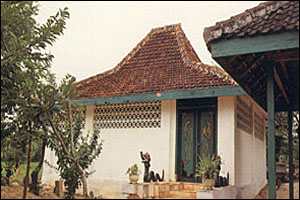 |
Apparent resting place of Brawijaya V (some say VII), last King of Majapahit, locat at Gedong Ombo |
 |
|
|
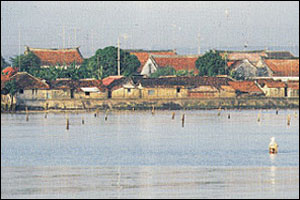
Chinese-style roofs on the skyline of the ancient port area |
|
On display in the government museum |
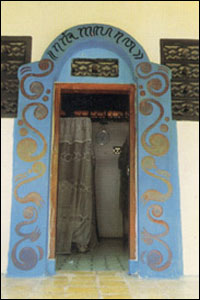 |
Entrance to the tomb of the hero Ronggo Lawe, second Regent of Tuban, dating from the early 14th century |
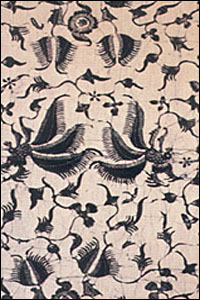 |
batik textiles continue to be made according to traditional methods in the region of Kerek, south west of Tuban |


Menu
Holy Mosques
The Walisongo
- Maulana Malik Ibrahim
- Sunan Ampel
- Sunan Giri
- Sunan Bonang
- Sunan Drajat
- Sunan Kudus
- Sunan Kalijaga
- Sunan Muria
- Sunan Gunung Jati